D to A
New Analog Studio
There is nowhere else I would rather sit all day!
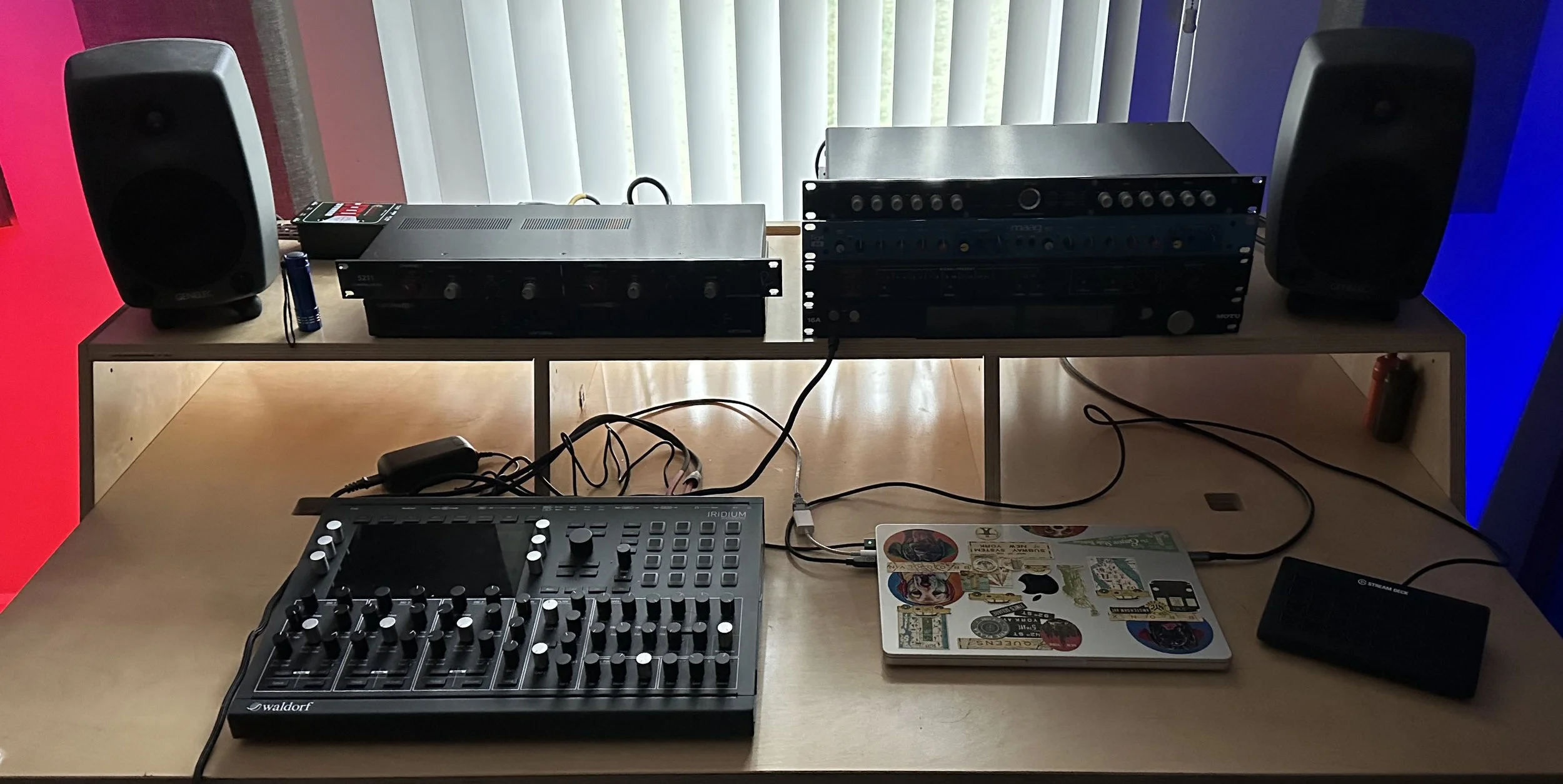
The pic is my studio as of 2026. Rather unassuming now that I look at it! The signal chains are as follows:
Synth tracking … Pro Tools MIDI via USB C —> Iridium —> JDI Stereo DI —> Neve 5211 —> MOTU 16a —> Pro Tools
Summing … Pro Tools —> MOTU 16a —> Dangerous 2Bus —> Maag EQ4M —> Elysia xMax (parallel outs: XLR —> MOTU —> Pro Tools, TRS—>Radial Sat-2 attenuator —> Genelec Powered NFs)
I don’t run the monitoring signal out of the MOTU from Pro Tools. I know that’s odd but I didn’t want to give up 2 line outs for monitoring. That way I have 8 Stereo Busses into the Dangerous 2Bus without adding an optical extension. Actually, monitoring straight out of the xMax forced me to learn one of two elusive skills I needed to run this studio. The first was multi-tracking a single analog synth (a topic for another day). But the second was to reach the loudness target of my final mix in the analog domain without clipping the converters on the way back into Pro Tools. Let’s explore that a little …
My print is digital but I wanted the xMax limiter to be the final processor with no ITB processing after the analog signal comes in the MOTU. The Elysia will consistently limit at a loudness threshold but it can’t be expressed in absolute DBs like a Fab Filter limiter. That plugin is amazing and is sample accurate in its metering. Analog limiters, on the other hand, don’t give a shit about clipping your converters. You find the analog ceiling of an analog limiter by pushing into it, finding the optimal settings, and using the final level control to calibrate the output to your loudness target. The target is best measured after the AD conversion back into Pro Tools on the AUX Input before the PRINT track. As long as the limiter output calibration is below the AD clipping level, you’re magic! Mixing for decades in the box would never have taught me this. Why would it?
I’m going to cover the second challenge in another post as it is a rabbit hole of serious proportions. But to wrap this up, I want to convey my impressions. First, working in analog has given me a whole new perspective on the meaning of ‘headroom’. In the digital realm, when you combine 20 tracks that peak at -1 db, you will likely blow out your mixbus and have to start pulling things down by 10 db or so. Summing in analog however, each output bus is a universe with it’s own headroom once it’s converted. AND a device like the Dangerous 2Bus has essentially infinite headroom to combine those busses into a single mixbus while bringing a clarity to the whole mix. It’s hard to explain but super easy to grasp when you hear it happening. In analog, you can push each stage in the chain as long as that gear can handle it. The only requirement is to calibrate the resulting signal to a point below the AD clipping threshold (assuming you don’t want to clip the input converters for color).
Another unexpected journey the new studio has sent me on is the practice of mixing with no plugins. It’s almost like I don’t need them until I want some particular change for purely aesthetic reasons - a room space, cut in the low end to make room for the kick, bumping at 2.5k for clarity. Now I think more in terms of level, balance, and panning. I do use plugins but I don’t have to. They are about preference and style rather than need. It’s a different mindset.
Finally, there is the sound. Oh man, I do not have a plugin that sounds like an Iridium passing through a Neve preamp. I can’t even replicate that with analog plugins. It sounds finished with a full body that I can subsequently carve to taste. With plugin synths, I am always trying to give the result more body and rarely have the luxury of being able to comfortably chisel it. Like mixing, the sound of analog equipment has shifted my mindset to a subtractive predisposition rather than an additive one. Some call it ‘warmth’. Whatever it is, I like it.
All that being said, I will still use Falcon, Pigments, Serum, Phase Plant, Modwave, Zenology, or pots and pans and a stick if I need to! That’s modern composition.
Tim
